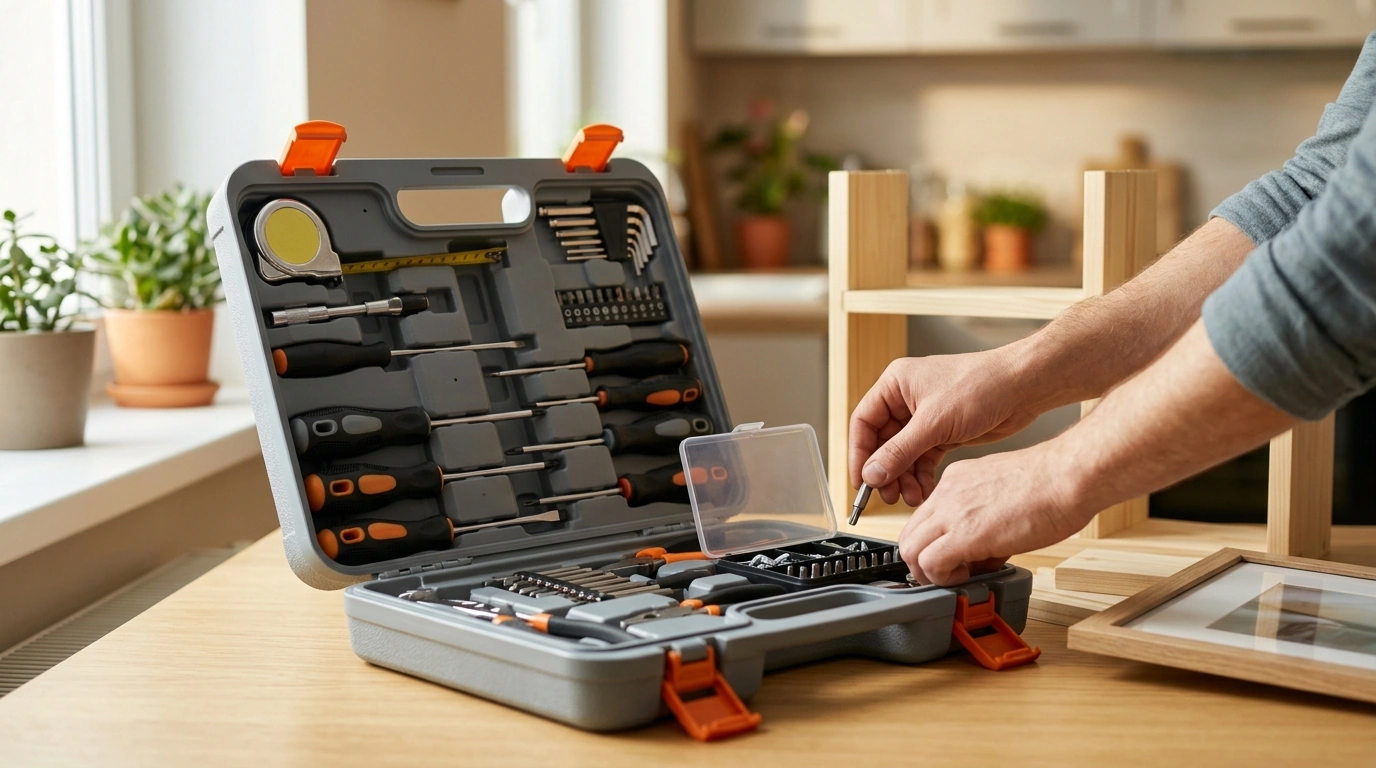
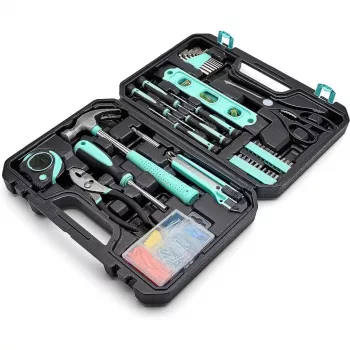
Small repairs and quick installations go smoother when the basics are organized in one place. A well-rounded kit helps with the everyday stuff that pops up in real homes—tightening a loose knob, hanging a frame, assembling a new shelf, or replacing a missing screw—without turning the closet upside down. The 142-Piece Household Toolbox and Storage Set is built for common home tasks—tightening, measuring, hanging, assembling, and light maintenance—while keeping accessories sorted for fast grab-and-go use.
For safe use, standard tool-handling practices matter as much as the tool itself—use the correct tool for the job, keep a steady grip, and avoid improvising with sharp edges or excessive force. OSHA’s guidance on hand and power tools safety is a helpful baseline for reducing common mishaps.
A 142-piece set is most useful when it combines core hand tools with a broad range of bits and small accessories. That variety is what makes it suitable for “unknown” household problems—where you won’t know the exact screw head or fastener size until you open the drawer.
| Task | Tools/Items Commonly Needed | Practical Tip |
|---|---|---|
| Tightening cabinet handles | Screwdriver/driver bits | Snug fasteners gently to avoid stripping |
| Assembling furniture | Driver bits, small hand tools | Sort screws by type before starting |
| Hanging a picture frame | Measuring tool, marking aid, basic hardware | Measure twice; level before final tightening |
| Replacing a loose doorstop | Screwdriver/driver bits, fasteners | Check for longer screws if the hole is worn |
| Quick household adjustments | Assorted hand tools | Use the correct size bit to reduce cam-out |
Household tool kits tend to “fail” when pieces get separated—one missing bit, a loose pile of fasteners, or sharp items rolling around in a junk drawer. A compartmentalized case turns a tool set from a one-time purchase into a repeatable system you’ll actually use.
For broader home-safety fundamentals—especially if you’re doing tasks on ladders, around children, or in high-traffic areas—CPSC’s home safety resources are a practical reference.
A household set is designed to cover routine problems quickly, not to replace specialized trade tools. Knowing the boundaries helps protect both your project and the tools themselves.
For most apartment tasks—tightening hardware, assembling furniture, hanging lightweight décor, and handling small replacements—a 142-piece set is typically plenty. Specialty projects may still call for add-ons like a drill/driver, stud finder, or plumbing-specific tools.
Keep the case in a dry spot, wipe tools after use, and return each item to its compartment so nothing rattles loose or goes missing. In humid areas, adding a small desiccant pack and doing occasional checks to restock bits or fasteners helps a lot.
A household toolkit focuses on general hand tools, driver bits, and small accessories for furniture and home hardware. A mechanic’s set typically emphasizes sockets, ratchets, and tools built for higher-torque automotive tasks and fasteners.





Leave a comment